

01
Decision document
The written case for what to build first — and what to leave alone. Read it in an hour. Defend it to a board.
DESIGN · STAGE 01 / 04
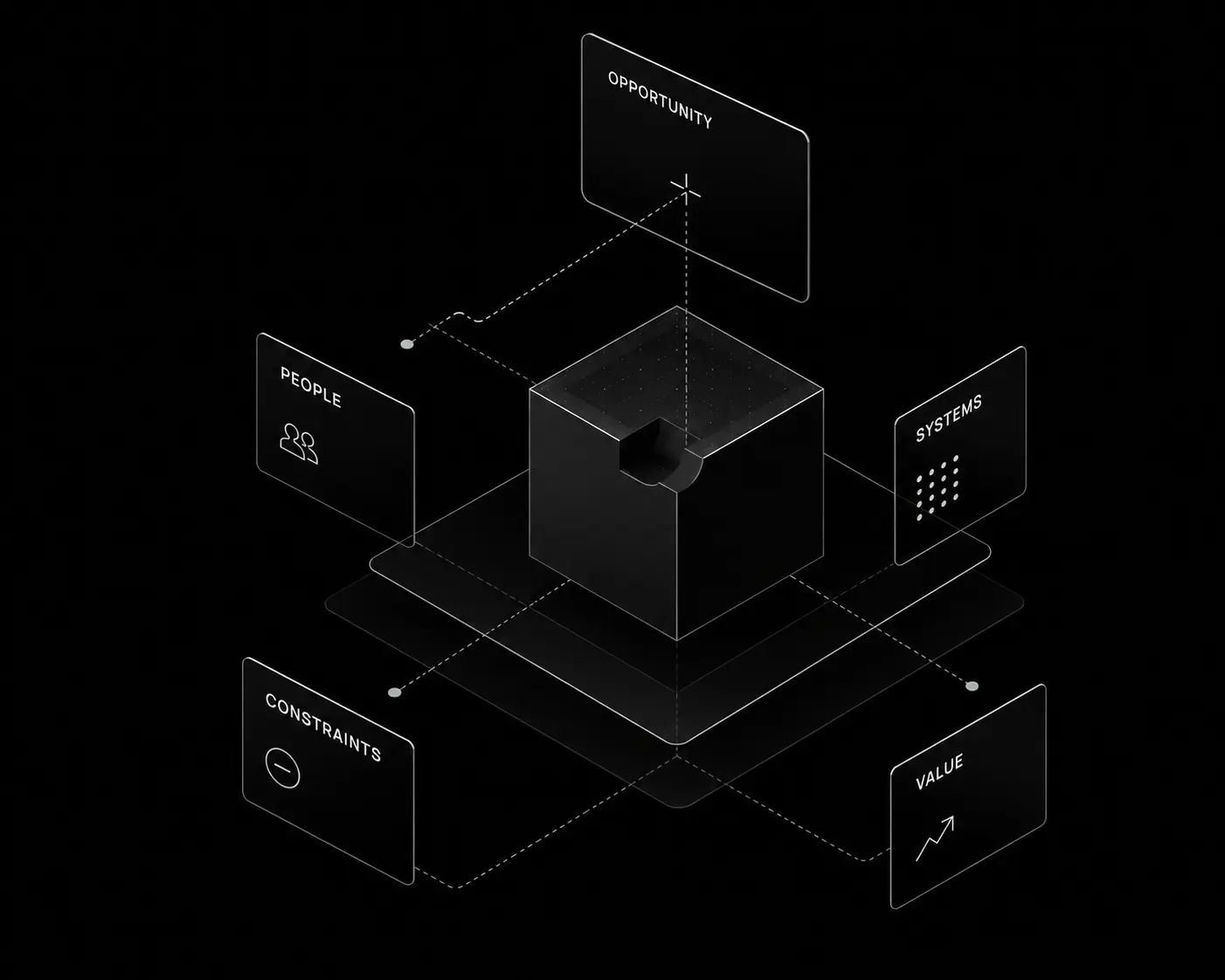
Discovery separates appetite from opportunity. Before anyone commits to a build, we map the people, systems, constraints, and value around the work — and put the case in writing.
WHAT YOU WALK AWAY WITH
Reproduced from real engagements and redacted where they must be. The redaction is part of the discipline you are buying.
The written case for what to build first — and what to leave alone. Read it in an hour. Defend it to a board.
Every candidate bet plotted against customer value, business expectation, and technical risk. One usually dies here. That is the point.
Who decides, who blocks, who has to run this after launch — mapped before they surprise the project.
An honest read on what your organization can absorb: capacity, readiness, and where change management will matter.
We will tell you when a project should not be built.
HOW IT RUNS
One real week beats any methodology diagram. This is the rhythm, not the highlight reel.
Stakeholder interviews — three of them, recorded and transcribed.
Systems walkthrough with your engineers. The architecture goes up on the wall.
Opportunity mapping session — every bet priced for value and risk.
Technical spike on the riskiest assumption. Code, not opinion.
Findings in writing. Decision review booked with your sponsors.
ENGAGEMENTS AT THIS STAGE
The workshops, sprints and engagements we run at this stage — scoped to where you are, not a fixed package.
The three perspectives we align
PROOF, NOT PROMISES
initiatives after discovery
A European energy group · ENERGY · IOT
WHO SHOWS UP
The team you meet is the team that does the work — cross-border, senior, and accountable by name. This is who discover brings into the room:

Vasil Gocevski
Co-Founder & CEO
“A decision maker sits in every discovery sprint. The honesty is structural.”
THE HANDOFF → STAGE 02
Discover ends in a decision. Define turns it into a shape — scope, prototype, and plan built directly on the discovery artifacts, not re-derived from scratch.
Related capabilities
ENTRY OFFER
A focused engagement that turns ambition into a written, evidence-backed decision: what to build first, what it must prove, and what to leave alone.
The decision document is yours — whoever you build with.